Sunday, September 13, 2009

natural disasters 2


Tsunamis

sunami can be caused by undersea earthquakes as the one caused in Ao Nang, Thailand by the 2004 Indian Ocean Earthquake, or by landslides such as the one which occurred at Lituya Bay, Alaska in.

Blizzards

Significant blizzards in theUnited States include:

[edit]Cyclonic storms

Cyclone, tropical cyclone, hurricane, and typhoon are different names for the same phenomenon a cyclonic storm system that forms over the oceans. The deadliest hurricane ever was the 1970 Bhola cyclone the deadliest Atlantic hurricane was the Great Hurricane of 1780 which devastated Martinique St. Eustatius and Barbados. Another notable hurricane is Hurricane Katrina which devastated the Gulf Coast of the United States in 2005.

[edit]Droughts

Well-known historical droughts include:

  • 1900 India killing between 250,000 and 3.25 million.
  • 1921-22 Soviet Union in which over 5 million perished from starvation due to drought
  • 1928-30 northwest China resulting in over 3 million deaths by famine.
  • 1936 and 1941 Sichuan Province China resulting in 5 million and 2.5 million deaths respectively.
  • As of 2006 Western Australia New South Wales Victoria Australia Victoria and Queensland states of Australia have been under drought conditions for five to ten years. The drought is beginning to affect urban area populations for the first time.
  • In 2006 Sichuan Province China experienced its worst drought in modern times with nearly 8 million people and over 7 million cattle facing water shortages.

[edit]Hailstorms

Hailstorms (AKA hailstones) are rain drops that have formed together into ice. A particularly damaging hailstorm hit Munich, Germany onAugust 31, 1986, felling thousands of trees and causing millions of dollars in insurance claims.

natural disasters


A natural disaster is the effect of a natural hazard (e.g. flood,(tornado) volcano eruption, earthquake, or landslide) that affects the environment, and leads to financial, environmental and/or human losses. The resulting loss depends on the capacity of the population to support or resist the disaster, and their resilience. This understanding is concentrated in the formulation: "disasters occur when hazards meet vulnerability." A natural hazard will hence never result in a natural disaster in areas without vulnerability, e.g. strong earthquakes in uninhabited areas. The term natural has consequently been disputed because the events simply are not hazards or disasters without human involvement.

Earthquakes

An Earthquake is a sudden shake of the Earth's crust.The vibrations may vary in magnitude. The earthquake has point of origin underground called the "focus". The point directly above the focus on the surface is called the"epicentre". Earthquakes by themselves rarely kill people or wildlife. It is usually the secondary events that they trigger, such as building collapse, fires, tsunamis (seismic sea waves) and volcanoes, that are actually the human disaster. As many of these could be avoided by better construction, safety systems, early warning and evacuation planning, the term unnatural disaster is not unwarranted.

Earthquakes are caused by the discharge of accumulated along geologic faults.

Some of the most significant earthquakes in recent times include:

Volcanic eruptions

  • Lava may be produced during the eruption of a volcano a material consisting of superheated rock. There are several different forms which may be either crumbly or gluey. Leaving the volcano this destroys any buildings and plants it encounters.
  • Volcanic ash - generally meaning the cooled ash - may form a cloud, and settle thickly in nearby locations. When mixed with water this forms a concrete like material. In sufficient quantity ash may cause roofs to collapse under its weight but even small quantities will cause ill health if inhaled. Since the ash has the consistency of ground glass it causes abrasion damage to moving parts such as engines.
  • Supervolcanos : According to the Toba catastrophe theory 70 to 75 thousand years ago a super volcanic event at Lake Toba reduced the human population to 10,000 or even 1,000 breeding pairs creating a bottleneck in human evolution. It also killed three quarters of all plant life in the northern hemisphere. The main danger from a supervolcano is the immense cloud of ash which has a disastrous global effect on climate and temperature for many years.
  • Pyroclastic flows consist of a cloud of hot volcanic ash which builds up in the air above under its own weight and streams very rapidly from the mountain burning anything in its path. It is believed that Pompeii was destroyed by a pyroclastic flow.

Plants


Plants are living organisms belonging to the kingdom Plantae. They include familiar organisms such as trees, herbs, bushes, grasses,vines, ferns, mosses, and green algae. The scientific study of plants, known as botany, has identified about 350,000 extant species of plants, defined as seed plants, bryophytes, ferns and fern allies. As of 2004, some 287,655 species had been identified, of which 258,650 are flowering and 18,000 bryophytes . Green plants, sometimes called Viridiplantae, obtain most of their energy fromsunlight via a process called photosynthesis.Aristotle divided all living things between plants (which generally do not move), and animals (which often are mobile to catch their food). InLinnaeus' system, these became the Kingdoms Vegetabilia (later Metaphyta or Plantae) and Animalia (also called Metazoa). Since then, it has become clear that the Plantae as originally defined included several unrelated groups, and the fungi and several groups of algae were removed to new kingdoms. However, these are still often considered plants in many contexts, both technical and popular.

animals


Animals are a major group of mostly multicellular, eukaryotic organisms of the kingdom Animalia or Metazoa. Their body planeventually becomes fixed as they develop, although some undergo a process of metamorphosis later on in their life. Most animals are motile, meaning they can move spontaneously and independently. Most animals are also heterotrophs, meaning they must ingest other organisms for sustenance.

Most known animal phyla appeared in the fossil record as marine species during the Cambrian explosion, about 542 million years ago.

Nearly all animals undergo some form of sexual reproduction. They have a few specialized reproductive cells, which undergo meiosis to produce smaller motile spermatozoa or larger non-motile ova. These fuse to form zygotes, which develop into new individuals.

Many animals are also capable of asexual reproduction. This may take place throughparthenogenesis, where fertile eggs are produced without mating, or in some cases throughfragmentation.

A zygote initially develops into a hollow sphere, called a blastula, which undergoes rearrangement and differentiation. In sponges, blastula larvae swim to a new location and develop into a new sponge. In most other groups, the blastula undergoes more complicated rearrangement. It first invaginates to form a gastrula with a digestive chamber, and two separategerm layers - an external ectoderm and an internal endoderm. In most cases, a mesoderm also develops between them. These germ layers then differentiate to form tissues and organs.

Monday, September 7, 2009

Nature


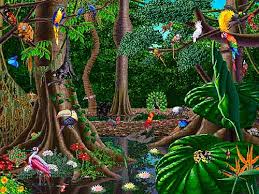
Nature is part of this world. Its a wonderful creation from heavens. I love nature and in this website you would learn information about nature. Ill talk about life on Earth, oceans, weather and many other things related to nature. So people who love nature this will be a very interesting blog to visit.